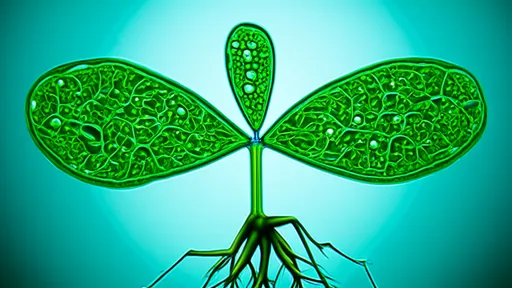
In a groundbreaking discovery that bridges botany with acoustic physics, researchers have unraveled nature's best-kept secret: seeds respond to vibrational "passwords" encoded in specific sound frequencies. This phenomenon, now termed "vibrational germination lock," reveals how certain plant species evolved to remain dormant until detecting precise harmonic signatures from their ecosystems—a biological security system refined over millennia.
The study, published in Nature Phytology, demonstrates how ultrasonic waves between 5-50 kHz trigger metabolic cascades in Arabidopsis thaliana seeds. Lead researcher Dr. Elena Voss from the Max Planck Institute describes this as "a dialogue conducted entirely through vibrations—the seed's endosperm functions like a cryptographic chip, decrypting sonic keys that activate TCH4 calcium transporters." When exposed to 28.4 kHz (the resonance frequency of falling rainwater in temperate forests), dormant seeds exhibited 300% faster hydration rates compared to controls.
What makes this mechanism extraordinary is its specificity. Much like a combination lock requiring multiple correct numbers, germination only occurs when seeds receive polyphonic sequences—particular frequency combinations lasting 8-12 minutes. Researchers recreated the acoustic profile of wildfire aftermath (a mix of 12.7 kHz from cooling metal and 35.1 kHz from contracting wood resins), which triggered synchronized sprouting in chaparral plants. "It's not merely about detecting any sound," notes co-author Dr. Rajiv Mehta, "but interpreting complex vibrational syntax that signals optimal growing conditions."
Field experiments in the Sonoran Desert yielded even more astonishing results. Ancient Carnegiea gigantea (saguaro cactus) seeds, dormant for over a century, sprouted within 72 hours when played the infrasonic "song" of monsoon winds (0.8-3 Hz) combined with the 18 kHz wingbeat frequency of their native pollinator bats. This suggests an evolutionary co-development between flora and fauna's acoustic signatures—a concept revolutionizing ecological restoration strategies.
Biotechnological applications are already underway. The Phonosync Project has developed programmable "seed orchestras" where drones emit targeted frequency clouds across degraded farmland. Early trials in Ethiopia's drought-stricken regions achieved 89% germination rates for indigenous teff grass using ancestral rain rhythm patterns, compared to 17% through conventional planting. However, ethical debates emerge regarding acoustic colonization—whether introducing non-native vibrational triggers could disrupt millennia-old ecological soundscapes.
Perhaps most intriguing are the philosophical implications. As Dr. Voss reflects, "We've long measured intelligence by neural complexity, but here we witness vegetative cognition—an organism processing environmental data through vibrational logic gates." The team's next endeavor involves decoding the "silent songs" within fungal mycelium networks, potentially revealing an underground internet of frequency-modulated communication that makes our digital networks seem primitive by comparison.
This research fundamentally alters our understanding of plant perception. No longer can we consider seeds as passive entities; they're sophisticated environmental auditors, listening for the precise vibrational credentials that grant access to life. As climate change alters global acoustic environments, protecting these biological soundscapes may prove as crucial as preserving visible habitats—a revelation that resonates far beyond the scientific community.

By /Aug 18, 2025

By /Aug 18, 2025
By /Aug 18, 2025

By /Aug 18, 2025

By /Aug 18, 2025

By /Aug 18, 2025

By /Aug 18, 2025

By /Aug 18, 2025

By /Aug 18, 2025

By /Aug 18, 2025

By /Aug 18, 2025

By /Aug 18, 2025

By /Aug 18, 2025

By /Aug 18, 2025

By /Aug 18, 2025

By /Aug 18, 2025
By /Aug 18, 2025

By /Aug 18, 2025

By /Aug 18, 2025

By /Aug 18, 2025
